
Summary of the 6th edition of the «ECODEF Talks» series of webinars on the effectiveness of cooperative armaments programmes

The 6e edition of this webinar, entitled «The ineffectiveness of European armaments cooperation programmes: a myth?», was broadcast live on Thursday 9 March 2023.
Moderated by the Engineer General of Armaments (2S) Olivier Martin, Chairman of the Chair's Steering Committee, this issue featured a discussion with Richard Ford, Head of International Missile Systems Cooperation at the UK Ministry of Defence, Expert Researcher in Missile Systems Cooperation at the UK Ministry of Defence, Expert Researcher in Missile Systems Cooperation at the UK Ministry of Defence. Defence Equipment and Support (DE&S) [1], and Josselin Droff, Doctor of Economics, Researcher at the Chair of Defence Economics - IHEDN, author of several contributions on European defence cooperation issues. [2] [3] [4].
Former arms attaché at the UK Embassy in Paris, Richard Ford presented his vision of effective armaments cooperation, based mainly on his extensive experience of Franco-British cooperation in this area and his recent research work on the subject, including a A summary article can be consulted on the Foundation for Strategic Research website.
The Chair offers you summary the main lessons learned from this webinar, including the full video is available on the Chair's YouTube page.
1era part
Overview of European cooperation programmes with a focus on Franco-British cooperation
Olivier Martin: Could you give us an overview of European armaments cooperation since the 1960s (nature, sectors involved, countries, etc.)?
Josselin Droff : To provide a quantitative overview of cooperation on armaments programmes in Europe from the late 1950s to the present day, we can start with a list of 83 programmes. These have been compiled from a variety of sources based on an in-depth study of the literature (case studies, institutional reports) and the specialist press for recent years.
We exclude abandoned programmes and cooperative programmes involving only one European country in partnership with a country outside Europe (e.g. C27J or Harrier II). On the other hand, we have retained in the accounts cooperation programmes involving several European countries with a third country (e.g. Tempest / Global Combat Air Programme including the United Kingdom, Italy, Sweden and Japan).
The chronological breakdown of programmes (Figure 1) shows that cooperation is a fairly old phenomenon. In terms of the number of cooperative ventures, the «golden age» was in the 1950s-1960s, followed by a sharp decline in the 1970s, an upturn in the 1970s-1980s, and another dip in the 2000s. The current period can be seen as a «revival of cooperation», with an increase in the number of projects, although there is no guarantee that they will come to fruition (e.g. MGCS with Germany) or that their structure will not be altered (e.g. Tiger MK 3 with the withdrawal of Germany).

This dynamic follows a cycle of investment in armaments during the Cold War (the 1960s in particular, then the major programmes of the 1980s-1990s and finally the end of the 2010s-beginning of 2020), combined with a more dynamic European policy in this area (particularly in the period from 2010 to the present day with the increased role of OCCAR). [5], of the EDA [6] or PESCO [7]), but also tighter budgetary constraints (particularly in the wake of the 2008 economic crisis) which are forcing governments to cooperate, in a context where systems are becoming increasingly expensive from one generation to the next (Augustine's Laws).
Over the period as a whole, cooperation was most marked in the aeronautics sector (aircraft and engines, helicopters with 35 programmes) and in missiles (20 programmes) (Table 1). Aeronautics in the broadest sense (aircraft and missiles) has accounted for two-thirds of cooperative armaments programmes in Europe over the last 70 years. By contrast, cooperation is much more limited in the naval sector (12 programmes, including 7 after 2010) and the land sector (8 programmes). The economic reasons for this imbalance lie mainly in fixed costs, particularly R&D, which are structurally and historically higher in the aerospace sector than in other sectors. [8].

It is also interesting to analyse the number of armaments cooperation agreements by country (Figure 2).
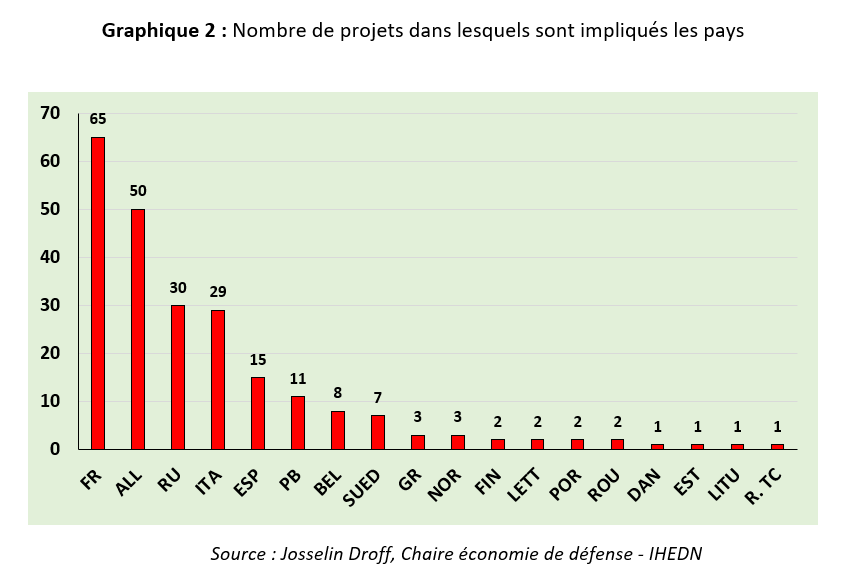
The participation of the main European countries in armaments cooperation varies considerably: France (65 participations) and Germany (50 participations) are the countries that cooperate the most. The United Kingdom (30 participations) is less involved. The UK was a major player in a number of major cooperative ventures in the 1960s, before sharply curtailing its involvement in the 1970s. It was not until the mid-1980s that this country began to play a significant role in European cooperation again.
Next comes Italy (29 participations), followed by Spain (15 participations), which did not join the European cooperation movement until the mid-1980s. Finally came the Netherlands (11 participations), with the other European countries having a much more limited involvement: Belgium (8 programmes), Sweden (7 programmes), Norway and Greece (3 programmes each).
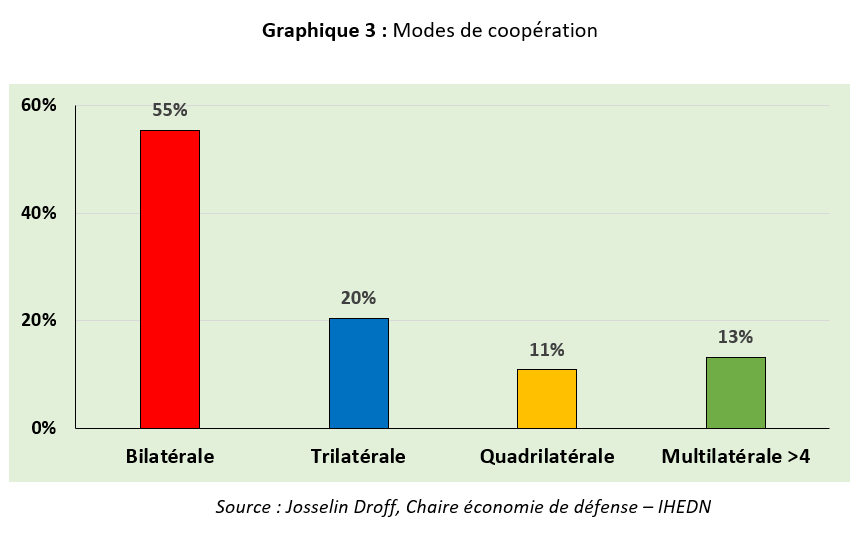
More than half of all cooperation projects are bilateral and 20% are trilateral (graph 3). Major projects involving 5 or more countries, while emblematic and relatively well studied in the literature, particularly through case studies (e.g. A400M), are still relatively rare (13% of cases).
The breakdown of cooperation methods differs significantly from one country to another
(graph 4). We can see that France gives priority to bilateral cooperation (57% of its participation in programmes), a share that is around 40% for the United Kingdom and Germany, but falls to 30% for Italy and only 7% for Spain.
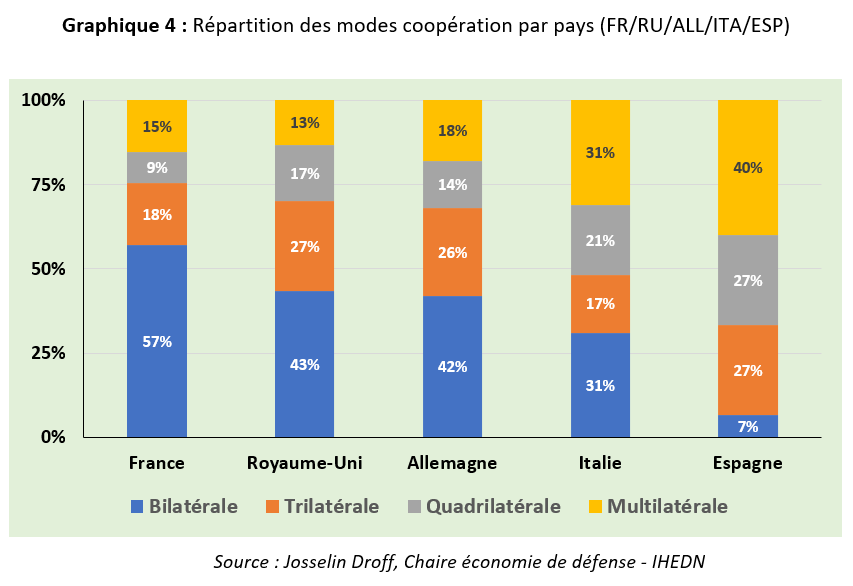
The UK, Germany and Spain have a slightly stronger preference for trilateral cooperation. Italy and Spain show a preference for inclusion in multilateral programmes.
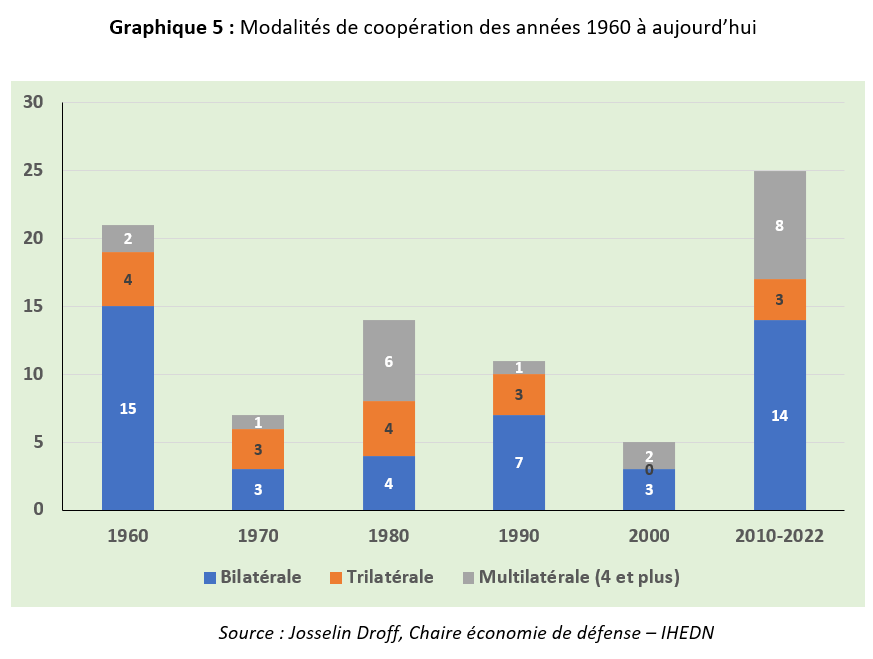
As part of an overall upward trend in cooperation, the evolution of cooperation modalities shows a certain «return to bilateralism» over the period 2010-2022, in comparison with the 1980s, 1990s and 2000s, combined with multilateralism (graph 5).
Olivier Martin: What is the position of the Franco-British couple within this European cooperation? What are the emblematic programmes and what developments are expected?
Richard Ford: France and the United Kingdom are the two largest military powers in Europe, both members of the UN Security Council, both nuclear powers. Our two countries aspire to have military and industrial capabilities covering the entire operational spectrum, are ready to deploy to external theatres and are members of NATO. These similarities were decisive in the signing of the Lancaster House Treaty in November 2010.
The results of this treaty were a resounding success at the political level and in terms of operational cooperation. In terms of capabilities, on the other hand, the results were interesting but less significant than expected. There are many reasons for this mixed record, including the following:
- The different views of these two countries on their relations with the United States and Europe;
- The different nature of relations with our industry;
- Traditional industrial and export competition;
- Different acquisition cultures;
- And last but not least, our cooperation skills are rather weak.
The middle of the previous decade saw a number of emblematic failures, notably in the aeronautical sector with the end of Franco-British cooperation between BAE and Dassault Aviation on the SCAF. [9] - France having decided to join forces with Germany - and the loss of cooperative MALE programmes [10] and tactical UAVs. Real efforts have been made in the maritime sector, both in terms of aircraft carriers and submarines, but these two initiatives have proved unfeasible.
The central pillar of industrial cooperation therefore remains the missile sector. Admittedly, since the signing of the Lancaster Treaty, the only success has been the launch of the ANL [11], However, it is true that we were at a low point in the investment cycle at the time. More recently, significant work has been done to prepare for the mid-life refurbishment of the Meteor missile (with 4 other European countries). [12]), a mid-life upgrade programme for the Scalp/Storm Shadow and Aster missiles have been launched, but the most important ongoing cooperation is clearly the FMAN/FMC [13], The aim is to replace the Scalp/Storm Shadow cruise missile and the Exocet and Harpoon anti-ship missiles currently deployed by the French and British navies respectively.
In short, we are undoubtedly guilty of excessive optimism when it comes to putting in place the resources for cooperative programmes: we often underestimate the complexity of armaments cooperation, we do not invest in it appropriately, particularly in terms of human resources, and then we ask ourselves why we are cooperating at all. At the same time, we often underestimate the expected benefits. For example, we think that a 2CV can tow a 70-tonne trailer and blame the 2CV when it breaks down.
Finally, the next Franco-British summit on 10 March 2023 will set a new course of action between the two countries. In particular, the new context linked to the Ukrainian conflict will probably lead to the concepts of interoperability and resilience being strengthened. In terms of resilience, the question will be whether cooperation can be deemed sufficiently effective to counteract the natural tendency for defence industrial activities to be relocated to national territory. This new period will certainly require vision and leadership.
2nde part
Main features of cooperation programmes
Strengths / Weaknesses - General conclusions
Olivier Martin: What are the main drivers for setting up cooperation programmes?
Josselin Droff : The main engines are as follows:
- Economies of scale, first and foremost. Cooperating means sharing not only the R&D effort but also the risks associated with that effort. This incentive to share costs is all the stronger given that the literature shows that the weight of R&D in defence systems is increasing. By adding a temporal dimension, the increase in the quantity produced also encourages learning economies, which are particularly marked in the aeronautics industry.
- Specialisation effects can also be sought, as each country can theoretically specialise in the stages of development and production where it is relatively the most productive and competitive. This is the theory of comparative advantage applied to the arms industry.
- Cooperative programmes enable a form of standardisation of equipment to be put in place, which promotes interoperability and provides a high level of security.
«In other words, »operational added value". More generally, cooperation strengthens military alliances. - Cooperation would reduce the likelihood of a programme being abandoned, as a decision by a partner to abandon a programme once it has been launched could raise major political problems.
- Cooperation is seen as an intermediate solution for maintaining jobs and skills in high-tech activities, particularly when a country does not wish to buy its equipment off the shelf (desire for independence), but cannot develop this programme on a purely national basis either (severe financial constraints).
- By encouraging agreements and cooperation between companies in the armaments sector, cooperation can help to create large groups capable of competing on a global scale (argument of critical industrial size) (e.g. MBDA). [14], EADS-Eurocopter [15]). Conversely, the naval and land sectors, where cooperation is more limited, are struggling to consolidate their industrial base on a European scale.
- Cooperation makes it possible to pool technological and scientific knowledge bases, as well as the ideas - and tactical designs - of the different staffs, which can lead to the development of better performing and higher quality equipment than a national knowledge base, which is by definition «narrower». As the spectrum of knowledge only increases, cooperation multiplies the potential for pooling knowledge bases between countries, a fortiori in a cumulative long-term perspective.
Olivier Martin: What are the challenges facing European cooperation?
Josselin Droff : The main difficulties faced by cooperative programmes are as follows:
- Differences in the timetables of the partner countries, linked to the mismatch in the timing of the countries' needs, make it difficult to plan cooperative investments. Of course, the problem becomes more acute as the number of partners increases.
- Cooperation has often led to the addition rather than harmonisation of operational requirements, resulting in more complex specifications. This contributes to higher development costs, longer development and manufacturing lead times and an overall increase in the complexity of the industrial supply chain. In some cases, specification divergences can lead to joint programmes being abandoned (e.g. France's withdrawal from the European fighter aircraft programme to launch the national Rafale programme).
- Setting up cooperative programmes and monitoring their progress involves more complex administrative procedures, which tends to increase programme monitoring costs (coordination and control costs) (e.g. Tornado, NH90, Eurofighter).
- Secondly, governments can use collaborative programmes to meet their own national industrial policy objectives, in particular by seeking to acquire technological and industrial skills during the development phases that they have little or no expertise in.
- The history of armaments programmes in Europe shows that cooperation is strongly influenced by the principle of «geographical fair return», which aims to ensure that each participant in the programme has an industrial charge established in proportion to its financial participation. In practical terms, this can lead to a proliferation of production or integration sites, which limits economies of scale and learning (e.g. Eurofighter, Tiger, C160 Transall, etc.).
The «theoretical» literature suggests that for cooperative programmes (compared to «national» programmes) :
- The costs generated would outweigh the benefits; ;
- Cost overruns would be greater; ;
- Development times would be longer, with delivery delays and therefore major operational consequences in terms of capacity.
Olivier Martin: In the Franco-British case, what is the significance of the various arguments put forward on the advantages and disadvantages of cooperative programmes?
Richard Ford: It is not possible to cover every aspect of Franco-British cooperation here. However, in my recent article
published by the FRS [16] that, from a financial point of view, cooperative programmes actually avoid very significant costs. This has tended to go unnoticed because of ideological considerations, mathematical errors and economic fallacies. This is a very important point because it is a fundamental reason for cooperation.
However, the benefits need to be understood more broadly, and even the financial benefits need to be understood more broadly than just at the level of development in the programme. So I think we need to think more carefully about cooperation. We tend to imagine that we are part of perfectly logical and functional organisations driven by good intentions and that cooperation is an extension of this. Cooperation is therefore often seen in a binary way - either as a kind of utopia or as a catastrophe. The reality is that cooperation is a good thing, but it is not perfect; it is beneficial, but not without additional costs.
We need to go beyond the economic analysis of cooperation. Like acquisition itself, this analysis requires a multidisciplinary and transdisciplinary approach. For example, behavioural economics, in particular the dispossession aversion bias, shows that we overvalue the things we «own» (by about 2 to 1). It is therefore unlikely that we place an appropriate value on cooperation, as seen from our national organisation. We are not as logical and rational as we like to think.
Similarly, institutional theory highlights the «softer» elements that can determine the behaviour of organisations, including cooperation partners. Our national procurement agencies are very well endowed, but their equivalents for collaborative programmes are relatively weak.
Let's start with trust, which we find is rare. We can undoubtedly cooperate without trust, but it is less effective and generally more limited. The relationship between BAES and Dassault around the SCAF was not characterised by trust, but they eventually found a way of working together, albeit unsuccessfully in the end, but for other external reasons.
Olivier Martin: Can you identify recurring success factors?
Richard Ford: In reality, the implementation of current cooperation is based on a form of chance, which resembles alchemy more than science. Waiting for the planets to align and uttering «magic spells» at midnight can sometimes work!
Academics want to reduce things to a single factor (usually political will), but there are several important factors that contribute to successful cooperation. So, to use an image, implementing successful cooperation can be like making a soufflé. Success depends on the ingredients, of course, but also on the preparation, the equipment, the temperature of the oven, and so on.
If I had to propose a «recipe» for successful cooperation, I would say that nothing is essential except a small group of people working to achieve it. The political will can be nurtured, deadlines, requirements and budgets can, within reason, be adjusted, and compromises can be negotiated without jeopardising the fundamental interests of cooperation.
However, if we want to consolidate the cooperation process by helping to strengthen its long-term benefits, we need to invest in three areas in particular:
- Aligned industrial groupings
A common industrial base and industrial vision in a given field are very useful, but, as MBDA has shown with the cooperation on the Scalp missile and then the Meteor, setting up cooperative programmes is also a very powerful vector for industrial rationalisation, which has made cooperation on these programmes even more effective.
We also need to support industry in finding a common interest in cooperation (joint ventures, cooperative technology demonstrators, information sharing and effective licensing agreements, particularly for exports).
- Permanent cooperation structures
We need effective cooperation structures. In the field of missiles, we have a solid set of cooperative projects, but we have three major structural components:
- CW ITP [17] The ITP, which was set up in 2008 between France and the United Kingdom, enables cooperative research in the field of missiles to be piloted. While it took 34 months to agree the standard intellectual property conditions for the 10 companies involved in the original ITP and to obtain the necessary stakeholder approval, once selected, cooperative research projects can now be notified in a maximum of 2 months, whereas previously it took at least 12 months to do so.
- Centres of industrial excellence. The centres of excellence ultimately lead to the use of a single industrial structure for the development and manufacture of missile subassemblies such as missile computers, missile data links, servo-motors and test benches. For example, the French MICA NG missile has servo-motors and a data link made in the UK, while the British Brimstone missile has a missile computer and a test bench made in France.
- JGPA [18]. The JGPA seeks to develop a global approach to missile cooperation based on the entire product portfolio. It is based on an ongoing dialogue between government and industry partners, early planning and a strong commitment from all parties, a guidance process to better structure cooperation and a focus on key success factors.
- Groups of people
Cooperation inevitably involves conflict. I would say that 90 % of the people involved in a given cooperation project see it negatively in the sense that they think it could have been done better at national level or that «the other party won», etc.
Admittedly, they are sometimes right, but most of the time they are wrong. In fact, within cooperation teams, it takes a sufficiently influential group of «believers» and committed players to move the lines, to tackle the myriad of objections, disagreements and recriminations .... In order to really get people to work together, the people in charge of cooperation programmes should be able to participate in future cooperation programmes, thus giving future programmes the benefit of their experience, making cooperation easier and more effective. Unfortunately, however, we tend not to keep these people on cooperation programmes, thereby negating the benefit of their learning.
If a national development programme is already complex, the complexity of a cooperation programme is certainly squared, if not cubed. More than anything else, it needs intelligent, innovative people with good intentions to make these cooperation programmes a success.
Questions from the audience
- Is the fair return policy working? Does it need to be changed, and is this being considered?
Josselin Droff : Fair return is a recurring theme in studies on the subject. The Organisation for Joint Armament Cooperation (OCCAR) has introduced a Global Balance policy. This policy does not fundamentally abandon the principle of «juste retour», but aims to implement it not by programme and on an annual basis, as has traditionally been the case for cooperative programmes (Eurofighter, FSAF, etc.), but in a multi-programme, multi-year approach. In this way, a leading country in a cooperative project can leave its place to another country for another project, and so on. However, the current difficulties over the distribution of roles in the SCAF or MGCS programmes have not been resolved. [19] show the limits of this approach, even though they were launched by France and Germany as part of a Global Balance approach, particularly in terms of industrial leadership.
The issue of fair return remains a stumbling block in the question of cooperative programmes. On the other hand, there are ways of improving this fair return by exploiting, for example, the economic and technological spin-offs linked to the operation of the equipment during its life cycle (maintenance, updates and modernisation, dismantling, etc.). Another approach could be to study the introduction of forms of compensation that are not necessarily directly linked to the armament programme itself (e.g. R&D subsidies, financial compensation, regional development aid, etc.). With this in mind, it is possible to draw on existing European mechanisms to compensate regions in countries that may lose out as a result of the choices made (e.g. ERDF programmes, etc.). [20] and INTERREG or Horizon Europe).
Richard Ford: In the Franco-British framework, following Lancaster House in 2010, there were around twenty programmes planned, which made it easier to rebalance the overall situation. Today, unfortunately, there are far fewer. I would say that you need trust between the players to make the Global Balance work, especially if one country is to decide to be the first to give up something.
- What is OCCAR's role at European level in harmonising the needs of its customers (the States)?
Richard Ford: OCCAR is not well placed to deal with this problem of harmonising requirements, as it intervenes too late in the process.
In reality, this mission falls within the remit of the European Defence Agency, but it is a very complex one, especially if there are a large number of partner countries. This makes it easier to launch bilateral cooperation programmes, which is confirmed by the data in the table presented by Josselin at the start of the webinar.
- Does European cooperation encourage the export of equipment resulting from this cooperation?
Josselin Droff : The few existing empirical studies on the subject, which focus mainly on aircraft, do not show that cooperative armament programmes outperform their competitors in terms of exports.
Richard Ford: I remember Jean-Laurens Delpech [21] which in 1976 discussed the consequences of cooperation in programmes on the export of the products concerned. [Editor's note: Jean-Laurens Delpech pointed out that «The difficulties of exporting a weapon produced in cooperation increase according to a geometric progression whose reason is n3, where n is the number of participants».». On a more positive note, he added that «In terms of export outlets, cooperative products benefit from the label of the various participating countries and are therefore likely to be of interest to a larger number of countries. This presupposes, however, that the participants agree on concerted promotion of their products and that their foreign policies do not create barriers to sales to certain countries, as is often the case.»] The export success of the Meteor missile confirms this increase in export opportunities, thanks to the missile's performance and its adaptation to three European platforms of partner countries (Eurofighter, Rafale and Gripen). To achieve this result, it is essential to address the export policy for the product concerned from the outset of the programme, which will have consequences for the technical choices that will be made subsequently (use of American components subject to ITAR regulations, etc.). [22]).
Olivier Martin: As part of the current cooperation between France and Great Britain, the export policy for products was the subject of an intergovernmental agreement (AIG), ratified by the parliaments of both countries and signed on 18 November 2016. Similarly, between France and Germany, an intergovernmental agreement was signed in 2019 specifying the rules applicable to the export of programmes carried out in cooperation between the state and industry.
Josselin Droff : Thus, given the difficulties in reaching agreement between countries on policies for the export of armaments produced in cooperation, some authors refer to parallel advances in foreign policy and defence policy at European level.
- Mr Ford, what is your analysis of the outcome of the SCAF and MGCS cooperation programmes?
Richard Ford: I won't answer your question about the MGCS. On the SCAF, the answer is complicated. The UK has historically chosen to work with the Italians and the Japanese. Since the Jaguar aircraft programme in the 1960s, France and the UK have never managed to agree on a combat aircraft programme. So it's not surprising that we now have two competing programmes in Europe. The fact that the UK is also opening up its programme to non-European partners such as Japan is a new departure.
- Is European cooperation compatible with the war economy, particularly in terms of simplifying specifications, increasing production rates and rationalising costs?
Richard Ford: The challenge is to achieve a level of efficiency in cooperation that has never been seen before in Europe. Thanks to the existing structures, we have the capacity to do better. Harmonising needs between European countries will certainly move up the order of priorities.
Josselin Droff : In fact, the conflict in Ukraine has really brought home the importance of harmonising requirements, the role of quantity in a conflict where attrition is high, and logistics. We can see the importance of these issues when we look at Ukraine, which favours the F-16 in its requests for fighter aircraft (an aircraft that is present in large numbers in NATO countries in particular, with proven logistics, relatively controlled costs, etc.). From this point of view, digital technologies - and digital twins in particular - can play a significant role by helping to define and simulate different equipment specifications as far upstream as possible, at reduced cost, as part of a design aid approach. Additive manufacturing can also contribute to the development of prototypes and different versions of equipment within short timescales and at reduced cost.
Olivier Martin: Let me add that cooperation programmes have to adapt to the different procurement practices of partner countries. Today, to meet the demands of the war economy, it is important for these agencies to simplify their procedures considerably. This is therefore a major and uniform effort to be made at the level of each State, but also at the European level, with a view to global convergence. There is certainly a great deal of regulatory work to be done on the standards applicable to armaments programmes. For example, it takes several years to integrate a missile under an aircraft in peacetime, but only several months in the event of a conflict. We undoubtedly don't have the same level of integration performance or even safety, but the context of war means that compromises have to be made.
- What is the impact of AUKUS cooperation on European cooperation?
Richard Ford: First of all, it should be noted that the announcement of AUKUS cooperation in autumn 2021 came as a surprise to many people in the UK, including myself. Personally, I think that the impact on Franco-British cooperation will ultimately be very limited in practical terms.
- What role do start-ups play in collaborative programmes, beyond their possible participation in upstream studies?
Josselin Droff : There has been little work on the subject of the subcontracting chain, and even less on SMEs and start-ups, mainly for reasons of industrial sensitivity. However, a study on the Eurofighter highlights the extent and involvement of all subcontractors and partners throughout the aircraft's life cycle. [23].
Moreover, the recent initiatives of the European Defence Fund (EDF) are moving in the direction of better integration of SMEs, beyond a simple scattering of funds. But these are mainly R&D projects, at least to date.
Richard Ford: The CW ITP (Franco-British bilateral initiative) has an architecture that gives SMEs room to integrate and propose innovations. Other mechanisms like this could be developed.
Olivier Martin: Under the ITP weapon complex, which was launched more than 15 years ago, the major prime contractors are contractually obliged to subcontract R&D activities to SMEs and start-ups. In terms of programmes, I worked a lot on this subject at MBDA. In the group's supply chain, there are of course many SMEs and SMIs (around 30-40% of the volume of subcontracted activity in the case of national programmes). We can imagine that this percentage is the same for cooperative programmes.
- Important decisions concerning cooperation are taken at a high political level, but this level changes regularly, which can affect support for cooperation programmes. Do we now have solutions to avoid this variability?
Richard Ford: We have to accept the fact that politics exists, because it is the basis on which our societies are run! The political authorities must therefore take the major decisions. They must then be provided with proposals and solutions for maintaining cooperative programmes that meet their requirements. In short, if the administrations are not in a position to present acceptable proposals to their political authorities, the latter will have to impose them on them.
- Is there a European body that harmonises the standards applicable to collaborative programmes?
Olivier Martin: I would tend to say that OCCAR should fulfil this role at European level.
Josselin Droff : Technically and historically, NATO plays a major role, via standards and in particular STANAGs [24]. NATO makes recommendations in this area, but then countries remain independent as to how they acquire them.
Richard Ford: By way of illustration, I can highlight the existence of programmes for the harmonisation of standards, for example for the standardisation of interfaces for the integration of missiles into airborne platforms between the United Kingdom, France and Germany. [25].
- How is industrial know-how financed by a sovereign state shared when it has been financed by a multinational (such as Thales) and the latter then receives an order from another country?
Richard Ford: There is a big problem with third countries in the European Defence Fund (EDF) and this is not acceptable to the UK. But on this particular issue, I have no knowledge.
Olivier Martin: I can add to this by giving the example of MBDA's industrial centres of excellence. The results of studies funded by country A (France or the UK, for example) at a centre of excellence remain the legal property of the national entity that carried out the study, but the results are made available free of charge to country B to meet its own needs.
- What is Britain's vision of cooperation with Germany?
Richard Ford: The UK certainly has a history with Germany through the Eurofighter and Tornado programmes, but personally I've never worked with the Germans.
Josselin Droff : It is worth pointing out, however, that recent cooperative programmes are not progressing optimally, or at least not as quickly as we would like (difficulties in reaching agreement on the SCAF, uncertainty over the MGCS project, Germany's withdrawal from the Tiger modernisation project, the Germans' choice of an American system for maritime patrol missions, etc.).
- Europe has launched a major programme to stimulate cooperation through the PESCO, EDF and other initiatives. [26] and Strategic Compass. How could these initiatives speed up the implementation of cooperation programmes between European countries or with third countries?
Richard Ford: Cooperation is mainly seen as a loss of control over competences or an opportunity to obtain an economic «juste retour». One way of changing this view would be to have a European investment fund. At the outset, the EDF was a good idea, but its practical implementation now poses a problem, particularly with the issue of integrating third countries, and therefore the difficulty of the United Kingdom's participation in studies financed by the EDF.
Olivier Martin: Richard, the UK's participation in the EDF studies seems possible to me, subject to an agreement being reached between the UK and the European Union. But I don't know whether there is a real British will to reach such an agreement with the EU. I hope there is.
Richard Ford: Yes, the UK is always ready to explore any avenue, but is it worth considering all 27 countries? Is it possible?
Olivier Martin: While the general agreement between the EU and the UK will have to be approved by all 27 countries, I would remind you that the financing of a programme by the EDF requires the cooperation of at least 3 countries, not 27. Another recent development is that the European Union, as part of its aid plan for Ukraine, is currently setting up a fund to purchase equipment from European manufacturers and Norway to replenish their stocks, particularly of ammunition. This initiative will undoubtedly encourage European countries to work together.
Josselin Droff : Earlier, we talked a lot about R&D and, more generally, the phases upstream of programmes, but there is also the whole downstream part. In this area, islands of cooperation exist and function, particularly in the use and support of equipment (e.g. on the C-130J between France and Germany). [27]. It is therefore appropriate to work on everything that contributes to bringing needs together [28] (e.g. European Intervention Initiative, long-term joint operations such as Atalante, etc.). Multinational military exercises are fundamental to improving interoperability and developing common doctrines. In the long term, this can encourage the definition of common specifications and ultimately reduce transaction costs in cooperative programmes.
[1] The views expressed by Richard Ford are his personal views and should not be considered as the views of UK Government
[2] www.cairn.info/revue-francaise-d-economie-2019-3-page-83.htm
[3] www.epsjournal.org.uk/index.php/EPSJ/article/view/286
[4] www.tandfonline.com/doi/full/10.1080/14751798.2022.2062886
[5] Organisation for Joint Armament Cooperation
[6] European Defence Agency
[7] Permanent Structured Cooperation (PESCO) or Permanent Structured Cooperation (PSC)
[8] Hartley, K. (2019), “The Political Economy of Arms Collaboration”, The Political Economy of Defence (in R. Matthews ed.), Cambridge University Press, pp. 235-257.
[9] Future Air Combat System
[10] Medium Altitude Long Endurance
[11] Light anti-ship
[12] Germany, Italy, Spain and Sweden
[13] Future Anti-Ship Missile / Future Cruise Missile
[14] Bellais R. (2022), “MBDA's Industrial Model and European Defence”, Defence and Peace Economics, vol. 33, no. 7, pp. 876-893
[15] Droff J. (2017) “The European military helicopter industry: trends and perspectives”, The Economics of Peace and Security Journal, vol. 12, no. 1, pp. 20-27
[16] Ford, R. (2022), “The myth of cooperative inefficiency”, FRS, DEFENCE&Industry n°16, June 2022, p. 32-39 : www.frstrategie.org/publications/defense-et-industries/myth-cooperative-inefficiency-2022
[17] Complex Weapons - Innovation and Technology Partnership
[18] Joint Government Procurement Agency
[19] Main Ground Combat System (Franco-German cooperation project in the field of heavy tanks, replacing the Leclerc (for France) and Leopard 2 (for Germany) tanks)
[20] European Regional Development Fund
[21] Ministerial Delegate for Armament from 1974 to 1977
[22] International Traffic in Arms Regulations. US regulations on the international arms trade.
[23] Matthews, R. & Al-Saadi, R. (2023), “Organisational Complexity of the Eurofighter Typhoon Collaborative Supply Chain”, Defence and Peace Economics, vol. 34, no. 2, pp. 228-243 : www.tandfonline.com/doi/full/10.1080/10242694.2021.1987022
[24] STANdardization AGreement
[25] Logical Store Interface Framework
[26] European Defence Fund
[27] Droff J. (2022) “European cooperation in maintaining defence equipment in operational condition: an analytical framework derived from economic geography”, Defense & Security Analysis, vol. 38, no. 2, pp. 169-189
[28] Droff J. and Malizard J. (2020) «Menaces, biens publics et demande de défense européenne», National Defence Review, No. 828, March 2020, pp. 95-100