

Sustainability of external operations
Julien Malizard - Josselin Droff
Researchers, Chair in Defence Economics
Summary: France has been involved in a large number of external operations costing over €1 billion a year for almost 10 years. An examination of the «additional costs of overseas operations» illustrates the new methods of intervention. The purpose of this contribution is to examine, from an economic point of view, the operational cost borne by the armed forces. This is a cost that is difficult to grasp because it has no economic value in itself, so we have to resort to indirect analyses, via the consequences for men and equipment. We show that, since 2010, there have been serious shortcomings that could ultimately lead to a reduction in France's military potential. Several avenues for improvement are then discussed in conclusion.
Abstract: France is involved in many overseas operations which cost has risen to more than one billion euros per year for almost 10 years. The evaluation of latter cost shows the new modalities of intervention of armed forces. This article aims at examining from an economic perspective the operational cost supported by the ministry of Armed forces. Due to a lack of economic value, the operational cost is complex to evaluate. Consequently, we proceed by an indirect analysis thanks to the assessment of the impact of overseas operations on both soldiers and equipment. We show that since 2010 major failures occurred. In the long run, this could reduce the military power of France. Several ways of improvement are discussed in the conclusion.
France is engaged in a large number of external operations (OPEX), the main ones of which are currently taking place in the Sahel-Saharan strip (Barkhane) and in Iraq-Syria (Chammal). These operations currently involve around 7,000 troops. With the soldiers mobilised for Operation Sentinelle and the presence and sovereignty forces in the French overseas departments and territories, more than 30,000 soldiers are involved.[1].
Current OPEX are characterised by seven structural dimensions, referred to as the «7Ds» by General de Villiers, the former Chief of the Defence Staff (CEMA): hardening, duration, delay, dispersion, dissemination, disinhibition and digitalisation (De Villiers, 2017). Confrontations are considered to be more dangerous than in the past, involving forces over several years, requiring very high levels of responsiveness, covering large areas over very long distances, confronting heterogeneous «true hybrid armies», constantly pushing back the boundaries of law and ethics, and imposing greater connectivity on the battlefield. Operational contracts, as defined in the 2013 White Paper on Defence and National Security, are regularly exceeded by around 30%, as the French Minister for the Armed Forces, Florence Parly, points out.[2].
OPEX also generate costs, known as «additional costs». After a phase of increase in the early 1990s (Gulf War and Balkans), additional costs decreased. Commitments have been on the rise since the early 2000s and have exceeded €1 billion for several years. Since 2000, the cost of these commitments has doubled. However, from a macroeconomic point of view, the additional costs of OPEX are low. On average over the period 1976-2016, they represent only 0.04% of GDP, 0.17% of public spending and only 1.48% of the public deficit.
Other costs are conceivable, and a large body of literature is devoted to identifying and assessing all the costs associated with a conflict. A recent example is the publication of Bilmes and Stiglitz (2008) on the American intervention in Afghanistan and Iraq, the total cost of which exceeds 3,000 billion dollars. We can then assess the macroeconomic cost of destroying part of the economic potential or the cost of caring for the military. At the cost of often restrictive assumptions (Smith, 2014), each cost is associated with a monetary value, the sum of all the costs then being the cost of the conflict.
Nevertheless, OPEX entail an «operational cost». This is a non-apparent cost, since it requires a precise assessment of the «drain» on military resources and the capacity to renew these same resources. We assume that it can be approximated by indicators of the effectiveness of equipment (availability rate) and personnel (hours of activity), which we then compare with indicators of the intensity of OPEX.[3].
Analysis of intensity per man involved
First, we quantify the budgetary consequences of military choices. Using data from the Cour des Comptes (2016), we break down the additional costs of OPEX into headings (personnel, operating costs and contribution to international operations) and then divide them by the number of men deployed on OPEX. This enables us to determine the «intensity per man deployed» (Chart 1).

We note a very sharp rise in the value of additional costs per man engaged, reflecting the tougher nature of the operations. Additional personnel costs remained virtually constant. As Hébert (2008) points out, additional personnel costs accounted for the bulk of additional OPEX costs in previous periods. From 2008 onwards, they have been outweighed by other additional costs (manufacturing-infrastructure, munitions, equipment maintenance, fuel, transport, operations and food). For example, the «munitions» item increased almost 10-fold between 2002 and 2015. Expenditure on equipment maintenance has tripled in more recent years. This is mainly due to the extreme conditions in which the equipment is used. For example, a VAB wears out 6.7 times faster in OPEX than in mainland France.
Budget trends illustrate the 7Ds highlighted by General de Villiers. Since 2008, we have seen greater participation in OPEX (measured by total additional costs) and the value of each man deployed has incorporated more equipment than previously.
Determining the operating cost
Based on this data, we have established the consequences of this increase in intensity on equipment availability rates and man-hours. The data used for the hours of activity are taken from the Annual Performance Programmes (PAP). Data on equipment availability are collected via various parliamentary documents, based on work initiated by Droff (2013) and continued in more recent work. We present an example from transport aviation (availability of C130 aircraft and hours of activity of transport pilots) but other examples confirm the same trends.

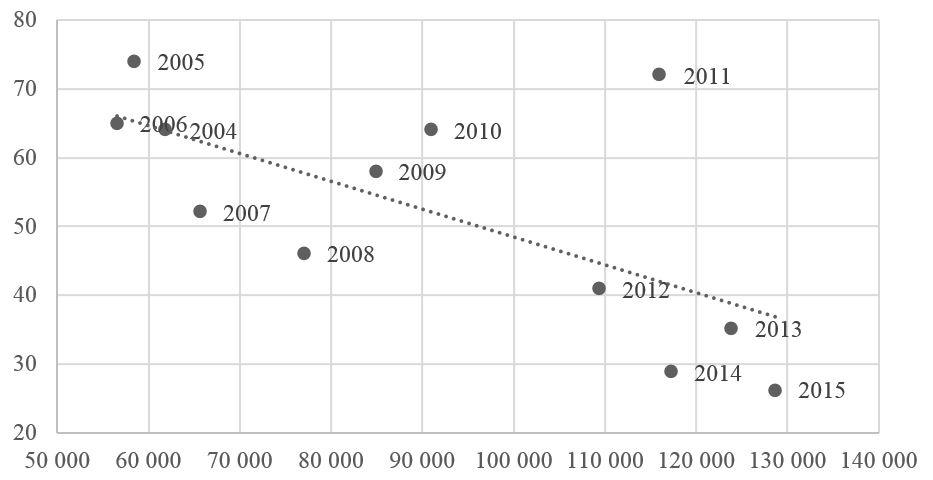
For both graphs, a linear trend linking the points on the scatter plot has been added. In both cases, the slope parameter of the trend is negative, which confirms the idea that as the intensity per man engaged increases, the men are less trained and the equipment less available. We note that training hours are structurally lower than the NATO target (400 hours) and that the C130 availability rate is dramatically low, despite significant tactical transport requirements. This suggests a preference for the present, leading to overuse of available resources, to the detriment of their renewal and regeneration.
To gain in generality, we study econometrically the role of additional costs on the availability of equipment (Droff and Malizard, 2017). The data covers 65 types of equipment over the period 1997-2016. In this approach, we make availability dependent on the real additional costs of OPEX and the age of the equipment. Overall, the effect of the additional costs is significantly negative and on average three times greater than the effect of the age of the equipment. With the exception of ships, all types of equipment are affected (armoured vehicles, aircraft), with an even greater prevalence for helicopters.
We then show that the consequences, for both men and equipment, are major. They are the result of a very tight budgetary constraint that is primarily affecting equipment (Droff and Malizard, 2014), while at the same time making OPEX tougher. The fact that we are falling behind the targets set by NATO in terms of hours of activity shows that there is a risk of downgrading. The equipment situation is also worrying, with capability gaps appearing in helicopters and strategic transport, for example.
On the sustainability of conflicts
At the end of this discussion, the question of the «sustainability» of operations appears to be crucial. As the Cour des Comptes reminds us (2016, p. 113), « The ability to supply and renew OPEX resources over the long term depends on the possibility of regenerating both major equipment and the operational capability of personnel at a sufficient rate, by providing them with adequate preparation. This dual requirement is not currently being met at a sufficient level. The risk is therefore that, in the long term, France will no longer be able to participate effectively in OPEX. From a practical point of view, it is therefore necessary to determine the degree of sustainability of the army model, in particular the military value created and the capacity to respond to decided strategic needs.
The sustainability threshold is defined when the drain on military capabilities is equal to renewal. Three avenues can be explored. Firstly, it would be necessary to improve the «yield» of men and equipment with constant budgetary resources, in a context where they are already extremely stretched with numerous reforms already initiated (all support and MCO in particular). Secondly, it is possible to abandon strategic ambitions, as the United Kingdom did after 2010, but this would run counter to the announcements made in the 2017 Strategic Review. Thirdly, a final option is to leave the strategic ambitions unchanged and increase the financial resources allocated to the Ministry of the Armed Forces in order to deal with operational contract overruns.
However, there are a number of challenges to the ramp-up. In the military, there is a shortage of supervisory staff and a lack of staff loyalty. In terms of equipment, there are difficulties in increasing production rates, given the scarcity of skilled labour, both in production and support.
None of these solutions is easy to implement. They require strong political decisions that will determine the future of the French armed forces for years to come. However, it should be remembered that the status quo is not a viable solution. If war has a cost, it is the price of peace that is now at stake.
Notes :
[1] EMA data, March 2018
[2] Hearing of the Minister for the Armed Forces before the Committee on National Defence and the Armed Forces, Report No. 2, session 2016-2017
[3] It should be noted that internal security missions are excluded from the analysis as we do not have sufficiently long and accurate data to carry out a statistical study.
Related articles from the Chair:
2017 - Papers presented by the Chair at the 21st Annual Conference on Economics and Security«
Bibliography
Court of Auditors. 2016. «France's external operations 2012-2015».
De Villiers, P. 2017. Serve, Fayard, 254 p.
Droff, J. 2013. «Le facteur spatial en économie de la défense: application au Maintien en Condition Opérationnelle (MCO) des matériels de défense,» Thesis for the doctorate in economics, Brest: Université de Bretagne Occidentale / ENSTA Bretagne.
Droff, J, and J Malizard. 2014. «Coherence between fiscal policy and the defence budget in France». National Defence Review, , no 769, p. 116-21.
Droff, J, and J Malizard. 2017. «Is France at war? Some new perspectives on the sustainability of current conflicts». 21st International Conference on Economics and Security, Royal Military Academy, Brussels, Belgium, 22-23 june.
Hébert, J.P. 2008. «20 billion euros for Opex since 1976». The Strategic Debate, , no 176-96.
Smith, R. 2014. «The Economic Costs of Military Conflict. Journal of Peace Research, vol. 51, no.o 2, p. 245-56.
Stiglitz, J.E, and L Bilmes. 2008. The Three Trillion Dollar War: The True Cost of the Iraq Conflict, New York: W.W. Norton.