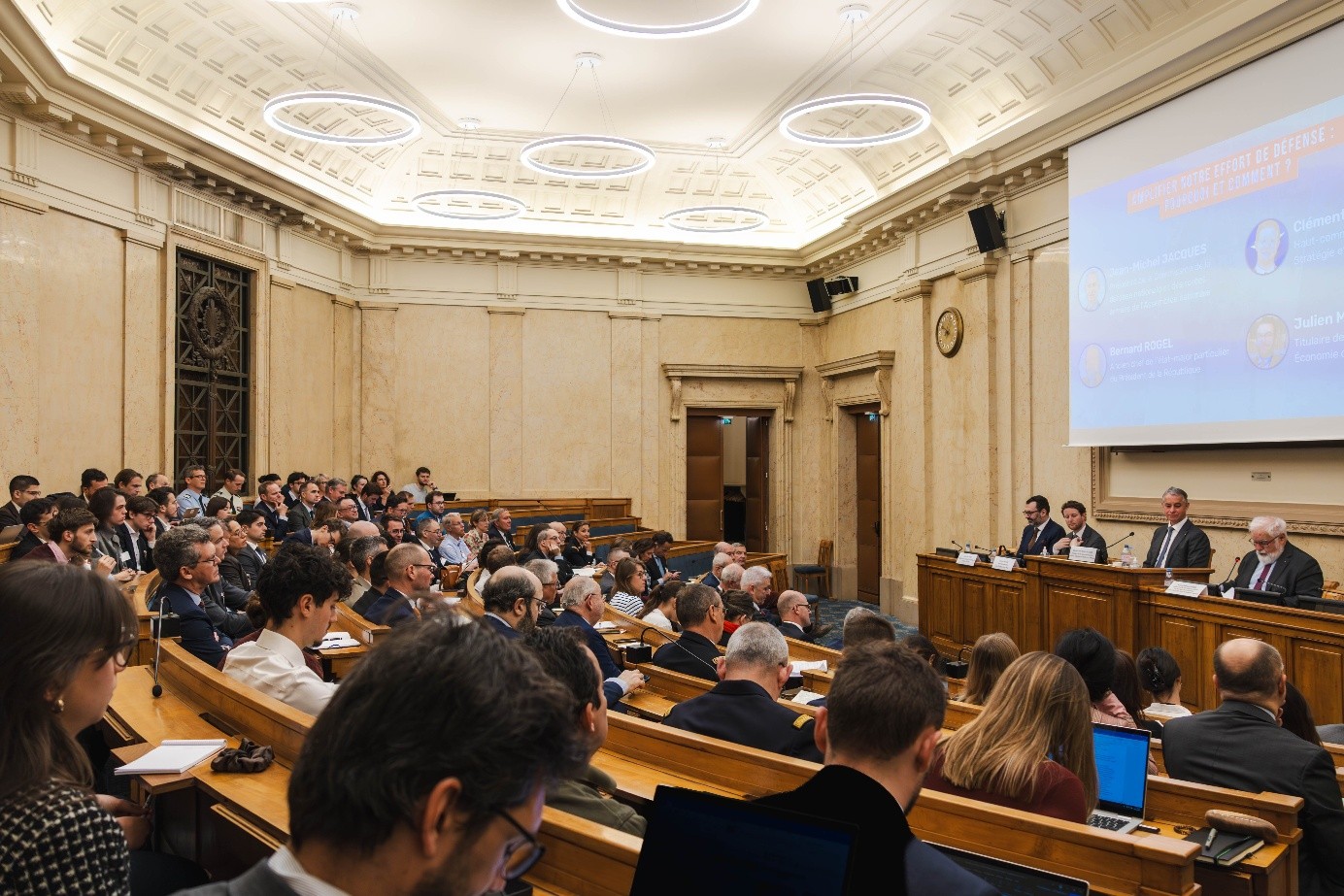

Julien Malizard took part in a conference organised on 17 April 2026 by Jean-Michel Jacques, Chairman of the National Assembly's Committee on National Defence and Armed Forces, on the theme of «Amplifying our defence effort: why and how?»
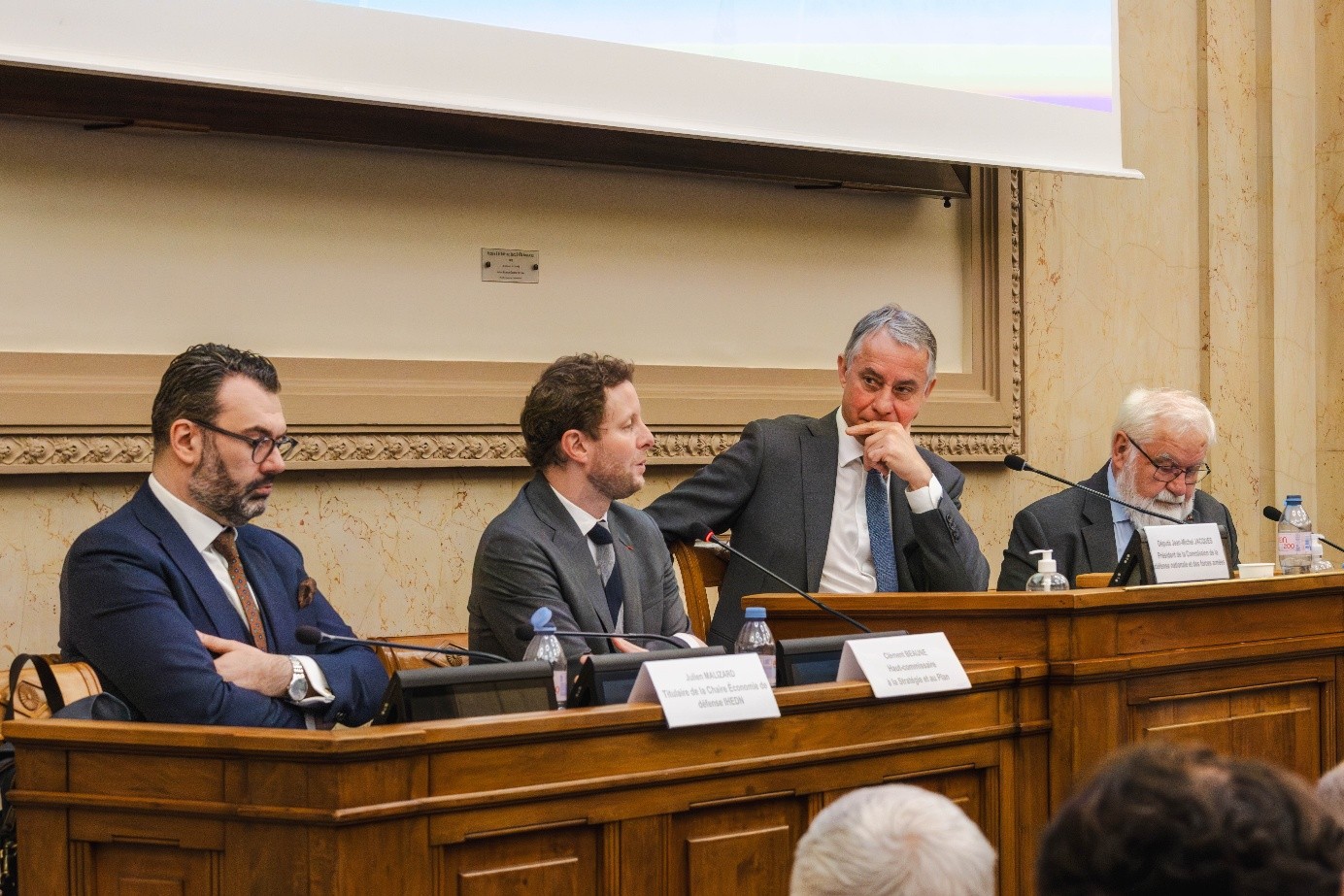
The conference also welcomed Admiral (2S) Bernard Rogel, former Chief of Staff of the Navy and former Chief of Staff to the President of the Republic, and Clément Beaune, High Commissioner for Strategy and Planning.
Julien Malizard's speech focused on three main points:
- European rearmament momentum now well underway
Since 2014, Europe has been experiencing a a sharp rise in defence spending, The increase in defence spending is expected to be in the order of +75 %, with the strongest increases observed in the countries of Central and Eastern Europe and Northern Europe. From this point of view, increasing defence spending from 2 % to 3.5 % of GDP would represent a major change, involving political and budgetary choices of varying degrees of constraint depending on the situation in each country. - Ongoing adaptation of the defence industry
To meet this additional demand, the defence industry has launched a transforming its production capacity. Procurement decisions continue to be based on the «cost - delivery - performance» triptych, but whereas cost has been the dominant criterion since the 1990s, the issue of delivery times has now become central. After an initial phase marked by the purchase of equipment from countries with large stocks, notably the United States and South Korea, substantial investments have been made to increase production capacity and reduce lead times. - The emergence of new industrial needs linked to mass creation
As well as adapting the historic industrial base, new needs are emerging, particularly in response to the need to create mass. In this context, a «new defence» market, which, in terms of its organisation, is closer to certain aspects of civil industry, is becoming increasingly important. This segment is characterised by stronger competition, the arrival of new entrants and the spread of innovative solutions. These developments call for the definition of a new industrial policy, capable of responding to these transformations.