
Financing military operations: from OPEX to Ukraine
Tuesday 2 June 2026
École militaire, Paris 7e
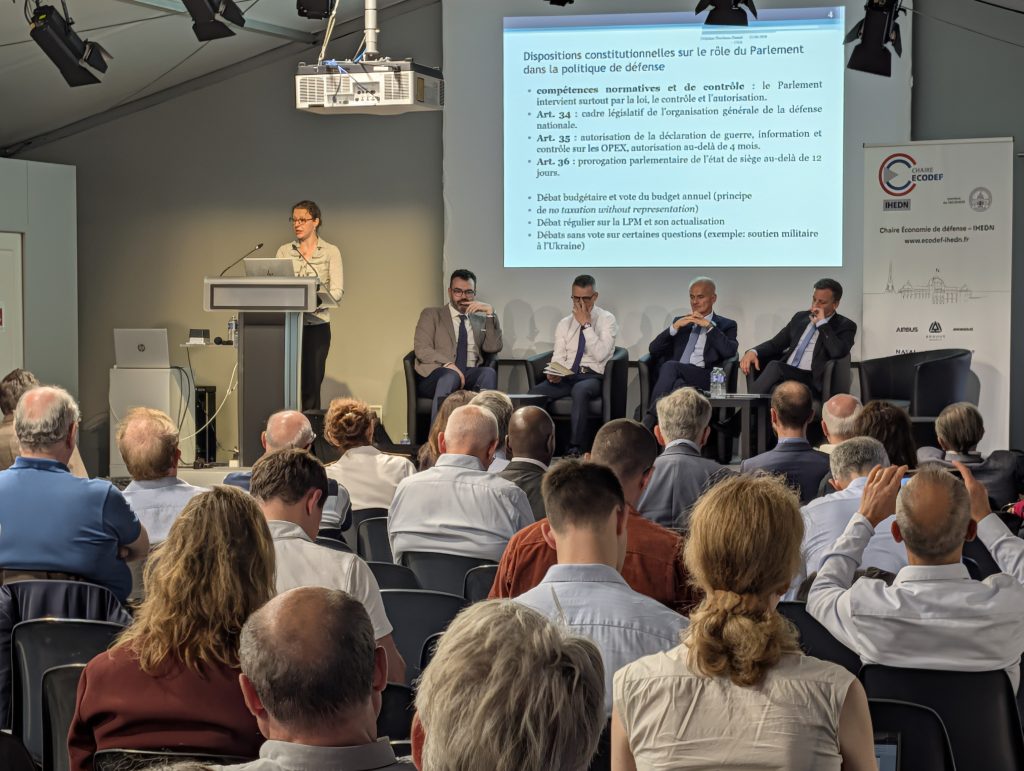
The Chair organised the symposium «The financing of military operations: from overseas military operations (OPEX) to Ukraine» on 2 June 2026 at the École Militaire, with the support of CEPEL (Centre for Political and Social Studies), a joint research unit (UMR 5112) in Political Science and Sociology affiliated with the University of Montpellier and the CNRS.
This symposium drew on research carried out as part of the PolisInWar research project, funded by the French National Research Agency (ANR) over a four-year period (2022–2026), which examines the methods of funding military operations carried out by the French armed forces since the early 2000s.
Structured around two round-table discussions, this event – which brought together various academic disciplines and insights from participants with diverse backgrounds – attracted around a hundred attendees.
The discussions focused in particular on the broad outlines of France’s defence policy, which occupies a special position amongst European countries in this field, thanks to the expeditionary capabilities of its armed forces and its frequent recourse to military interventions: analysis of the funding of military operations, possible budgetary instruments, the process by which political preferences are formed, identification of lines of division within the various government departments involved in these issues, the consequences of the choices made, etc.
Programme
Opening
Guillaume Giscard d'Estaing
Chairman of the Steering Committee of the «Defence Economics - IHEDN» Chair»
Introductory remarks
Jean Joana
Professor, University of Montpellier
Round-table discussion: «On the expeditionary mindset…»
Since the 1990s, military operations have multiplied and the associated costs have risen sharply, topping the billion euro mark by 2013. Adaptation to a post-Cold War armed forces model was combined with a failure to comply with military programming laws until 2014. The financing of military operations, the most visible activity of the armed forces, has gradually become a subject of debate.
- Josselin Droff, Researcher, Chair of Defence Economics - IHEDN«
- Olivier Zajec, Professor, Lyon-3 University
- VAE (2s) Olivier Lebas, Airbus Defence Advisor, Former Maritime Prefect for the Atlantic
- Delphine Deschaux-Dutard, MCF, University of Grenoble Alpes
Round-table discussion: «…on preparations for high-intensity warfare»
Without totally calling into question the post-Cold War foundations, the all-out war in Ukraine since February 2022 marks a turning point in strategic objectives. In addition to the previous missions, we are now providing military support to Ukraine, preparing for high-intensity coalition warfare and transforming our industrial base. The nature of military operations is also changing, from external operations to operational missions.
- Catherine Hoeffler, Professor, University of Geneva
- Samuel Faure, Researcher, IRSEM
- IGA Nicolas Grangier, Head of Economic Security, Defence Industry Division, DGA
- Elie Tenenbaum, Director of the Centre for Security Studies, IFRI
About the project PolisInWar
Two fundamental questions are at the heart of the project: to what extent does the funding of these operations impact on the State's ability to deploy military force, and what are the power issues surrounding this funding?
To achieve this, the PolisInWar project uses both qualitative and quantitative methods.
The research team brings together political scientists, economists and legal experts from various French and European institutions, including the University of Montpellier, the University of Grenoble Alpes, the IHEDN Chair in Defence Economics, the University of Geneva and Bundeswehr University.
Programme ANR-22-CES53-0007 PolisInWar / Defence policy and the financing of military operations in France